
Practical guidance · Linclips
How to turn customer reviews into marketing for your local business
Turn customer reviews into Google replies, branded social posts and useful local blog articles, with practical fictional examples and a weekly workflow.

Turn customer reviews into marketing by using specific feedback in three ways: a thoughtful Google-review reply, a branded social post and a useful local blog article. Keep the customer’s meaning intact, check permission before republishing their words or identity, and add facts your business can verify. Each format should do a different job—not repeat the same testimonial everywhere.
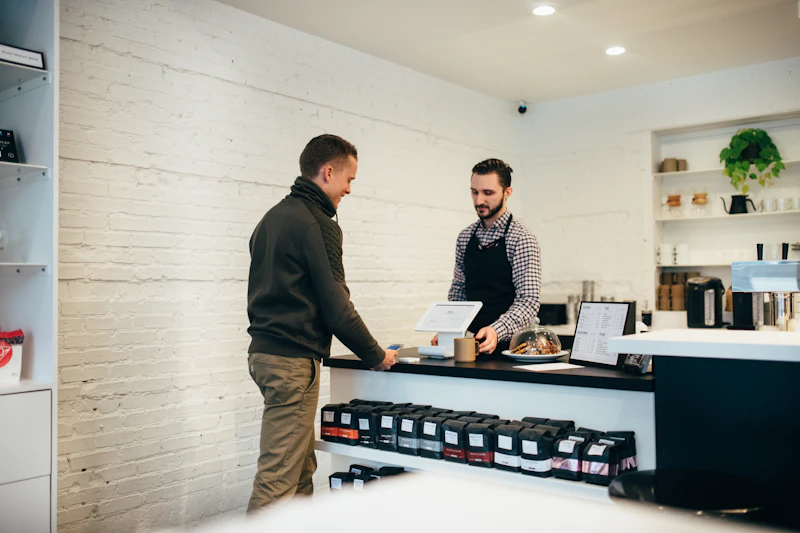
The café scene is illustrative stock photography, not a Linclips customer or the fictional business below.
Start with a detail, not just a star rating
A useful review tells you what mattered to a customer: a clear explanation, a welcoming visit or help choosing the right service. That detail gives you something concrete to respond to and a topic other customers may care about.
Before reusing a review:
- Save the original wording, source and date so you can check the context.
- Check permission and the review platform’s reuse rules before sharing quotes, names or screenshots. A public review is not blanket permission for every marketing use.
- Leave out private service details, especially health, financial or other sensitive information.
- Keep answering critical feedback too. Selecting a positive review for a post is not a reason to ignore a complaint.
Here is one starting point we’ll use throughout the guide.
Fictional, hand-authored example—not a real review, endorsement or Linclips agent output: Willow Wheel Workshop is an invented bicycle repair business in Southville, Bristol. Its fictional reviewer, Alex, says:
“The team explained what was wrong with my bike in plain language. I left with the repair sorted and a better idea of what to check before my next ride.”
The useful theme is clear explanations. The review does not say the workshop is the cheapest, the fastest or the best in Bristol. Don’t add those claims.
1. Write a Google-review reply that acknowledges the experience
A Google-review reply is a public conversation with the reviewer, not an advertisement. Thank them, acknowledge the detail they mentioned and keep the response short. Google’s guidance on review replies recommends relevant, conversational responses rather than promotions, and protecting privacy when responding to concerns.
Fictional, hand-authored reply to Alex:
“Thanks, Alex. We’re glad the explanation helped and that you left knowing what to check before your next ride. We want bicycle repair at our Southville workshop to feel straightforward. Thank you for sharing your experience.”
The service and neighborhood fit naturally into the reply. A string such as “best bicycle repair Bristol cheap bike repairs Southville” would distract from the customer’s feedback. Don’t force a target phrase where it sounds unnatural or assume that adding keywords improves rankings.
For a critical review, acknowledge the concern and offer a private contact route when appropriate. Don’t turn it into promotional content or publish account details to defend your business.
2. Turn the same feedback into a branded social post
A review-based social post helps someone who has not visited understand a specific part of your service. Choose one short quote, use a readable layout with your business logo and colors, and write a caption that adds context instead of repeating the graphic.
Fictional, hand-authored social concept for Willow Wheel Workshop:
- Graphic: “The team explained what was wrong with my bike in plain language.” In a real post, use an authorized quote with an appropriate source credit. In this example, label it “Fictional review example.”
- Caption: “A repair visit is a chance to understand your bike, too. At Willow Wheel Workshop in Southville, Bristol, we explain the work and welcome questions about what to check next. Have a repair question? Ask our team.”
- Image choice: A real photograph of the workshop or repair work, used with permission. Don’t attach an unrelated stock portrait as if it shows Alex.
Use large enough text for a phone screen. For a story, shorten the quote rather than shrinking it. If you shorten a real review, don’t remove a qualification that changes its meaning. Paraphrases belong in your own caption, not inside quotation marks attributed to the customer.
3. Use the review’s theme to write a useful local blog article
A local blog article should answer a question, not simply wrap a review in several paragraphs. Use feedback to identify what people need help understanding. Then add practical advice and verified city, neighborhood and service details.
For the fictional bicycle workshop, the theme suggests this question: “What should I ask during a bicycle repair visit in Southville, Bristol?”
Fictional, hand-authored article opening:
“A bicycle repair visit in Southville, Bristol is a chance to ask what caused the problem, what work is proposed and which checks are appropriate before your next ride. At Willow Wheel Workshop, we encourage riders to ask for an explanation in plain language. Advice should relate to your bike and the repair, rather than a generic checklist.”
A useful outline would cover:
- What caused the problem, and how the workshop identified it.
- What the proposed repair includes, with any estimate confirmed by the business.
- Which checks are appropriate for that particular bicycle.
- When the rider should return for help.
The original review gives you a theme—not evidence for every sentence. Have a knowledgeable team member check technical advice. Confirm local details; don’t invent nearby landmarks, service areas or a customer’s circumstances to make the article sound local.
Make review marketing a manageable weekly routine
As a starting routine, set aside a short weekly review session. Handle feedback needing a response, choose one suitable review for social content and look for a recurring question that deserves a blog answer. Agencies can use the same process separately for each client, keeping quotes, business details and permissions with the correct account.
| Output | Its job | Check before use |
|---|---|---|
| Google reply | Acknowledge the customer’s experience | Tone, privacy and relevance |
| Branded social post | Show one concrete aspect of the service | Permission, quote accuracy and source credit |
| Local blog article | Answer a useful local customer question | Facts, technical advice and local details |
Measure the work before making outcome claims: whether replies are relevant, posts preserve the original feedback and articles answer real questions. Traffic or inquiries can inform later decisions, but a change after publication is not proof that one review post caused it.
Where Linclips fits into the work
Linclips helps local businesses and digital agencies turn reviews into recurring marketing through three agents:
- SEO Agent: Automatically replies to Google reviews with natural, personalized responses incorporating the business’s target keywords.
- Social Agent: Selects strong reviews and publishes branded posts and stories on Instagram, Facebook and TikTok.
- GEO Agent: Reads recent reviews and writes a weekly localized blog article mentioning the business’s city and neighborhood. This is blog writing; automatic article publication is not confirmed.
Relevant account connections and business setup are still needed, and your team should keep oversight of facts, permissions and tone. These outputs do not guarantee search rankings, inclusion in AI answers or new customers.
Ready to see how this fits your business or clients? Explore Linclips to see the three-agent workflow and your next steps.